9 March 2026
Built at the Table
The Question
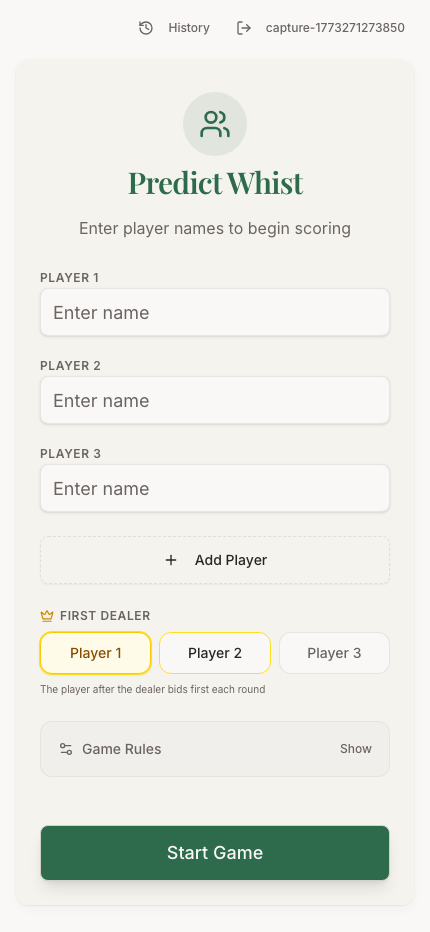
Whist Scorer started with a very ordinary problem: a group of us were on a ski trip, trying to play Whist, and the admin was awful. The game runs across fourteen rounds, with predictions, results, and running scores to track every time. Doing that manually on paper or in Notes felt fiddly and distracting.
The hypothesis was simple and brutally practical: if the pain is real enough, could an AI-built tool be useful almost immediately, before anyone has time to overthink it? This was not a startup idea first. It was a real-world annoyance that needed removing on the spot.
The Build
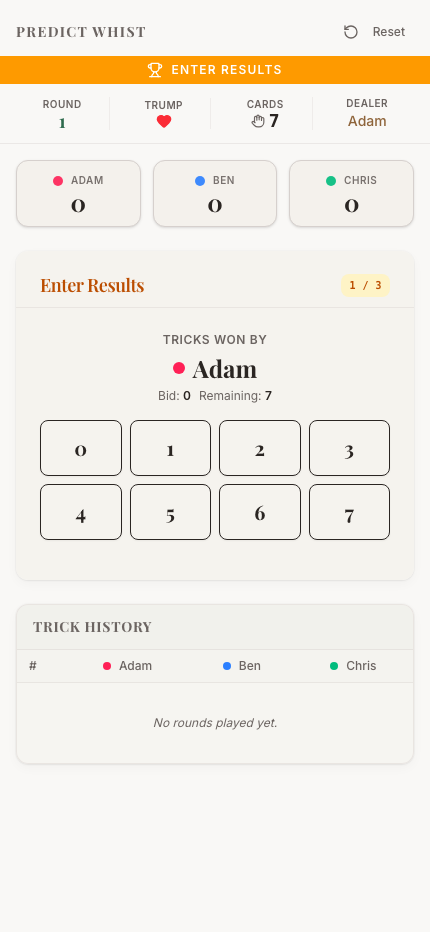
I asked the one person who really knew the rules to talk through what they would want in an app, then used Wispr Flow to push that prompt straight into Replit Design Mode. Within minutes there was a first pass we could actually use. Because only three of us needed it locally, that first version did not need a deployment pipeline or polished distribution. It just needed to be open on a screen and legible enough for the table to use.
That immediate feedback loop made the second iteration much better. After the first game, I got five WhatsApp notes on what needed changing. I added those plus a few UX tweaks of my own, mainly around what information stays visible at all times. That mattered because the app became a shared display for the group, not just a private calculator. A better hierarchy meant fewer interruptions and fewer reminder questions from everyone else at the table.
The interesting part was not technical sophistication. It was compression. The whole cycle from need, to spoken requirements, to working interface happened at table speed. That made the app feel less like a planned product and more like an extension of the game itself.
The Outcome
This is the clearest example I have of “have a need, build a solution.” The app removed an actual annoyance in about five minutes. That alone was enough to make the whole experiment feel profound. It did not just simulate usefulness. It was useful immediately, in the exact setting that produced the idea.
The surprising part was how fast the path went from hacky prototype to something I was happy to publish. I ended up buying whistscorer.com through Replit Domains and putting it live for everyone. I still have no idea how large the addressable audience for Whist scoring software really is, but I do know the problem is real for anyone playing the game properly. The next step is testing whether it makes sense as a real iOS app, possibly at a tiny paid price point, once I have an Apple developer account.
Tech Stack
Replit, Wispr Flow, mobile web app UI, domain publishing, Whist scoring logic